


Future Growth of Catheters Market

Amid the global shift toward precision medicine and minimally invasive care, the Catheters Market is gaining strong momentum as a critical enabler of modern interventional procedures across cardiovascular, urology, and neurology domains.
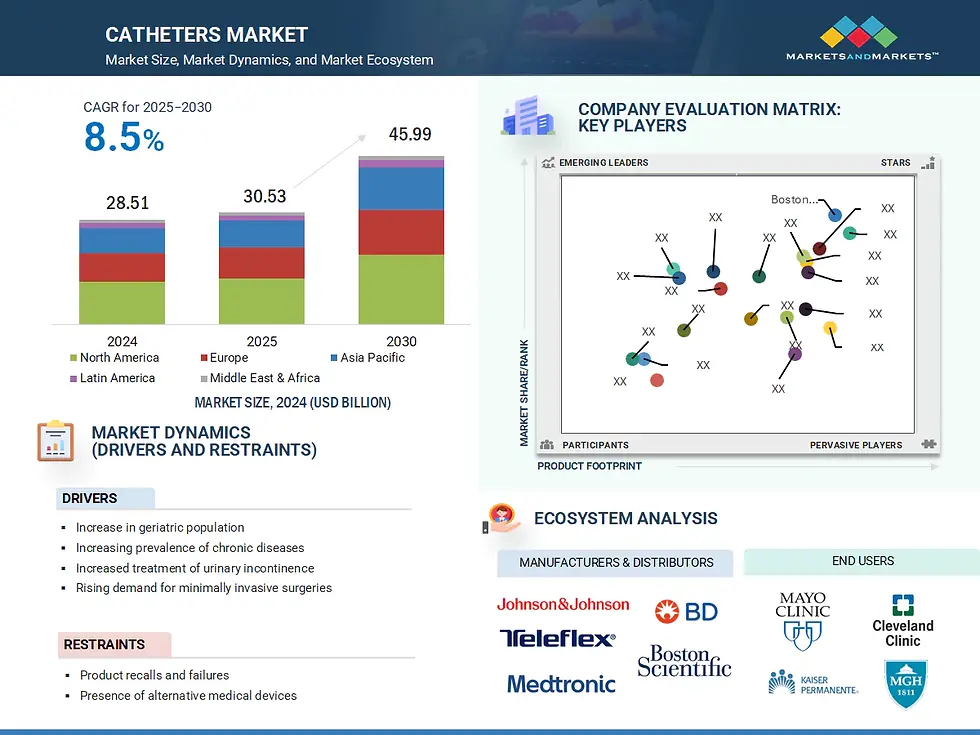
According to the latest research, the global catheters market is projected to grow from USD 30.53 billion in 2025 to USD 45.99 billion by 2030, registering a CAGR of 8.5% during the forecast period. The report, spanning 455
data tables and 67 figures across 415 pages, provides a comprehensive analysis of market dynamics, segmentation, and regional trends shaping the industry.
Download PDF Brochure:- https://www.marketsandmarkets.com/pdfdownloadNew.asp?id=6247803
What Is Fueling the Growth of the Catheters Market?
The increasing adoption of minimally invasive and image-guided procedures is a primary driver of market expansion. Why is this shift accelerating? Healthcare providers are prioritizing procedures that reduce patient trauma, shorten recovery times, and improve clinical outcomes.
Technological innovation is further transforming catheter-based interventions. Advanced features such as pressure-sensitive and steerable catheters, drug-coated devices, and infection-resistant coatings are enhancing procedural precision and reducing complication risks. At the same time, the integration of AI-based navigation systems and real-time imaging—especially in interventional cardiology and neurology—is enabling clinicians to perform complex procedures with greater accuracy.
Additionally, the development of hybrid catheter laboratories and advanced surgical suites in high-end healthcare facilities is expanding the scope of catheter-based treatments. Combined with the rising prevalence of chronic and lifestyle-related diseases, these factors are driving sustained demand and shaping long-term market growth.
Which Segment Dominates the Market?
By type, cardiovascular catheters accounted for the largest share of the global market in 2024 and are expected to grow at the fastest rate through 2030.
What explains this dominance? The increasing incidence of cardiovascular diseases—including coronary artery disease, heart failure, and arrhythmias—particularly among aging populations, is significantly driving demand. These conditions often require catheter-based procedures such as angioplasty and ablation, making cardiovascular catheters indispensable in clinical practice.
Moreover, advancements in drug-eluting and imaging-compatible catheters have improved safety and procedural outcomes. Growing awareness of early cardiac intervention, coupled with favorable reimbursement policies, is further supporting adoption. Continuous R&D investments by leading manufacturers are also accelerating innovation and segment expansion.
Where Is the Fastest Growth by Indication?
The neurovascular conditions segment is projected to witness the highest CAGR during the forecast period.
How is this segment evolving? The rising prevalence of neurological disorders such as stroke, brain aneurysms, and arteriovenous malformations is increasing the need for catheter-based interventions. The adoption of minimally invasive neurovascular procedures—enabled by advancements in microcatheters, guidewires, and embolization technologies—is significantly boosting demand.
Improved awareness around early diagnosis and better stroke management outcomes is encouraging timely treatment, while the expansion of specialized stroke centers and neurointerventional teams is enhancing access to advanced therapies.
Why Is Asia Pacific Emerging as a Strategic Growth Region?
Asia Pacific is expected to register the highest growth rate in the global catheters market during the forecast period.
What factors are driving this regional surge? The rising prevalence of chronic diseases such as cardiovascular and kidney disorders, combined with a rapidly aging population, is creating strong demand for catheter-based procedures.
In addition, improving healthcare infrastructure, increased patient awareness, and growing government investments across countries such as China, India, and Japan are accelerating market expansion. The presence of local manufacturers offering cost-effective catheter solutions, along with the growing adoption of minimally invasive surgeries, further strengthens the region’s position as a high-growth market.
Strategic Market Landscape
Key players operating in the global catheters market include Boston Scientific Corporation, Medtronic PLC, B. Braun SE, Becton Dickinson and Company, Stryker Corporation, Abbott Laboratories, Terumo Corporation, Coloplast A/S, Convatec Group PLC, Merit Medical Systems, Johnson & Johnson Services, Inc., Cook, Edwards Lifesciences Corporation, Nipro Corporation, Teleflex Incorporated, Cardinal Health, Hollister Incorporated, Integra LifeSciences Corporation, Koninklijke Philips N.V., and MicroPort Scientific Corporation.
These companies are actively investing in product innovation, digital integration, and global expansion to strengthen their competitive positioning.
Why This Matters for Industry Leaders
For CEOs, medical device innovators, and healthcare investors, the catheters market represents a critical growth frontier shaped by rising clinical demand and rapid technological advancement.
What strategic priorities should leaders focus on? Investing in next-generation catheter technologies, expanding presence in high-growth regions like Asia Pacific, and aligning with the global shift toward minimally invasive care will be essential to capture long-term value.
As healthcare systems continue to evolve toward precision, efficiency, and patient-centricity, catheter-based solutions will remain central to delivering high-quality, scalable care.


Comments